

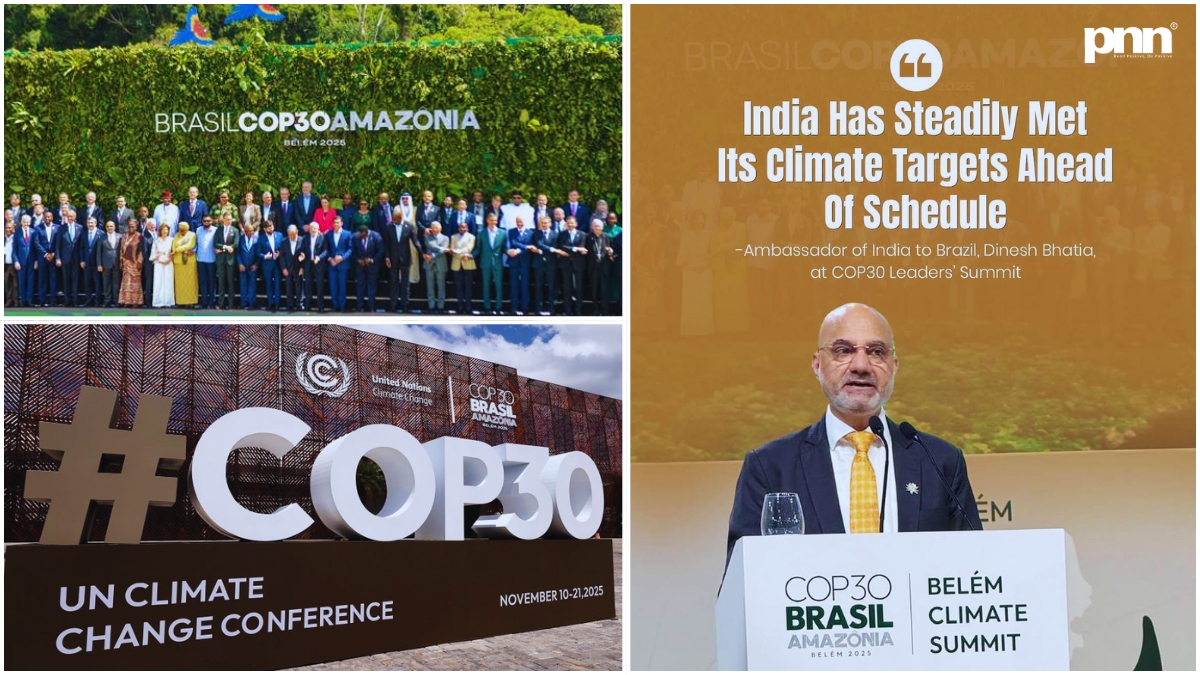
New Delhi [India], November 8: At COP30 in Belém, India didn’t just show up, it showed spine. Reaffirming its climate commitments, India told the world what few dare to: equity first, excuses later.
India’s Message: Equity Isn’t Optional
At the Leaders’ Summit of the UNFCCC COP30 in Belém, Brazil, India set the tone with clarity. Ambassador Dinesh Bhatia, speaking for New Delhi, restated India’s climate philosophy, anchored in equity, fairness, and common but differentiated responsibilities (CBDR-RC). In other words, developing nations can’t carry the guilt of industrialized nations’ emissions.
The message was blunt: developed countries must accelerate emission cuts and deliver the “promised, adequate and predictable” support, not another decade of pledges without payoffs.
This year’s COP is more than a diplomatic ritual. It’s the tenth anniversary of the Paris Agreement, a fitting time to measure how the world has performed. Spoiler: the report card isn’t great.
The Numbers Behind the Rhetoric
India’s record is hard to argue with. Between 2005 and 2020, the country reduced the emission intensity of its GDP by 36%, a milestone achieved years ahead of target. Non-fossil power now makes up over 50% of India’s installed capacity, five years before schedule.
India also expanded forest and tree cover, creating an additional carbon sink of 2.29 billion tonnes of CO₂ equivalent between 2005 and 2021. It has become the world’s third-largest producer of renewable energy, with nearly 200 GW of installed renewable capacity.
Numbers like these don’t just make a case, they make a statement. While others debate carbon credits, India builds solar parks.
Add to that the International Solar Alliance (ISA), a global coalition of 120+ countries co-founded by India. The ISA’s mission? Democratize access to clean, affordable solar power. It’s the kind of quiet revolution that deserves more headlines than it gets.
Who’s Falling Short?
Ten years after Paris, many nations’ Nationally Determined Contributions (NDCs) still fall short of keeping the world within the 1.5°C limit. India didn’t mince words: developing countries are doing the heavy lifting, while global ambition remains “inadequate.”
The statement called out the rapid depletion of the global carbon budget, a polite way of saying that the developed world is burning through the planet’s limits while talking about targets.
Affordable finance and technology access, India stressed, are not favors but prerequisites for equitable climate progress. Without predictable, concessional funding, most developing countries simply can’t implement ambitious climate plans.
It’s the same story every COP: big promises, small print. India’s intervention at Belém cut through the diplomatic fog.
Brazil’s Green Gambit and India’s Support
India also backed Brazil’s newest initiative, the Tropical Forests Forever Facility (TFFF), calling it a “significant step” toward global preservation of tropical forests. By joining as an Observer, India positioned itself as both a partner and a pragmatic player.
Brazil’s move aims to pool long-term resources for forest conservation, particularly in the Amazon. India’s endorsement strengthens the initiative’s legitimacy in the Global South, signaling that climate responsibility can coexist with sovereignty.
The Road Ahead: Action, Not Anniversaries
India’s closing note at COP30 was simple: implementation matters more than declarations. The next decade of climate action must focus on resilience, fairness, and shared responsibility.
The country reaffirmed its faith in multilateralism but warned that the architecture of the Paris Agreement must be preserved. Translation: don’t let shifting geopolitical interests dilute the core principle of equity.
The world may love big targets and catchy slogans, but India’s stance is about delivery. Ten years since Paris, the time for applause is over. The time for results has begun.
India’s Position: A Reality Check for the Global North
What makes India’s stand remarkable is its balance of confidence and credibility. The country has walked the talk, investing heavily in renewables, electric mobility, and carbon sinks, while ensuring growth for 1.4 billion people.
Contrast that with industrialized nations that built empires on fossil fuels, and the hypocrisy becomes clear. India’s climate diplomacy is no longer defensive; it’s strategically assertive. It reminds the world that “ambition” without equity is just greenwashing.
For India, COP30 isn’t about optics; it’s about ownership of the narrative.
