

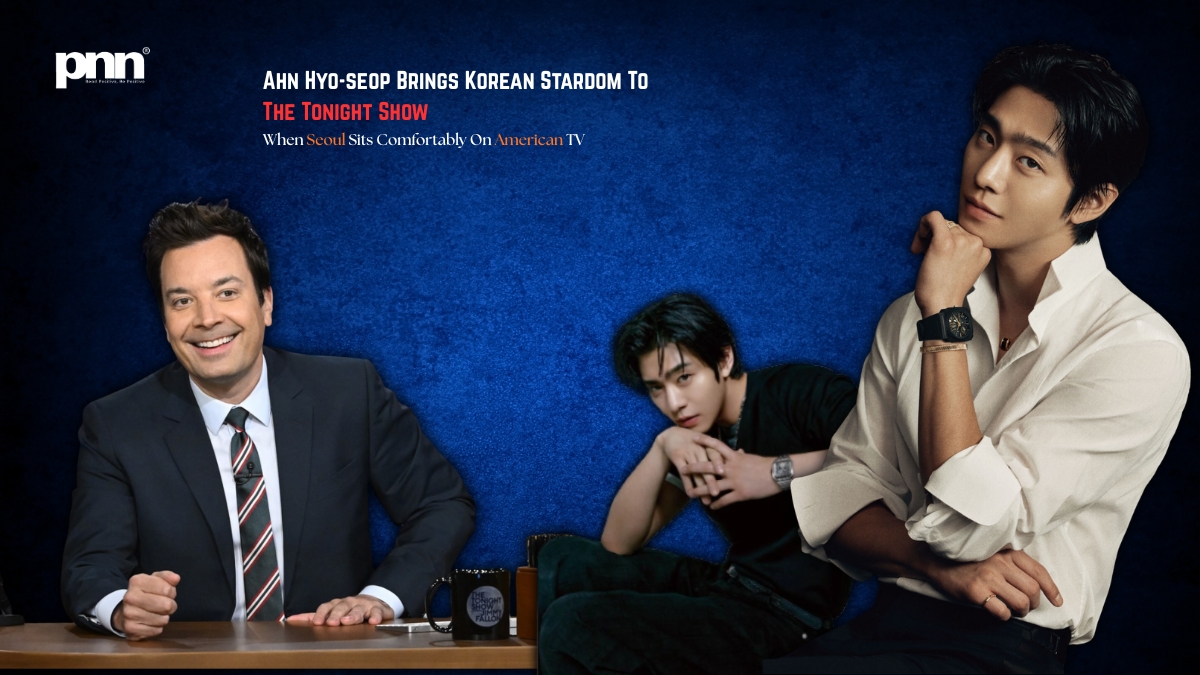
Mumbai (Maharashtra) [India], January 10: When a Korean actor steps onto an American late-night stage, it rarely arrives as a loud announcement. No fireworks. No manifesto. Just a chair, a smile, and a conversation carefully calibrated for laughs between commercial breaks. Yet Ahn Hyo-seop’s upcoming appearance on The Tonight Show in early 2026 is not merely another celebrity stopover—it is a cultural checkpoint disguised as casual television.
The move feels inevitable. It also feels overdue.
Ahn Hyo-seop is not new to global attention. What’s changing is the ecosystem around him. Korean actors no longer arrive as “introductions.” They arrive as recognisable figures with existing fanbases, measurable reach, and proven commercial value. Late-night television, once a Western gatekeeping ritual, is increasingly a validation stop—not a starting line.
That distinction matters.
This moment isn’t about breaking into America. It’s about how America is slowly, somewhat reluctantly, learning to meet global entertainment on equal footing.
The Long Arc Behind The Overnight Moment
Ahn’s rise didn’t happen because global audiences suddenly discovered subtitles. It happened because Korean entertainment invested in narrative consistency, production polish, and export-ready storytelling years before Western platforms took it seriously.
Before the animated spectacle of K-pop Demon Hunters introduced his voice to newer audiences, Ahn had already built a layered résumé across romantic dramas, fantasy series, and character-driven storytelling. His appeal was never manufactured around trend cycles—it grew out of repetition, reliability, and emotional fluency.
That matters in a late-night context. These shows are not built for nuance. They are built for charisma distilled into seven minutes.
And Ahn fits that format uncomfortably well.
He’s fluent in English, camera-aware without being stiff, and trained in a media culture that values restraint over spectacle. In other words, he doesn’t need to try too hard. Which, ironically, is exactly what works on American television.
Why Late-Night Still Holds Symbolic Weight
Yes, streaming platforms have diluted the power of network TV. Yes, TikTok clips often outperform the original broadcast. And yet, late-night appearances continue to function as cultural shorthand.
They say: this person matters beyond their niche.
For Korean actors, this platform has historically been inaccessible unless attached to awards campaigns or viral anomalies. What’s changed is intent. Studios and distributors are now placing actors into Western media cycles proactively—not reactively.
This is not accidental integration. It’s a strategy.
But strategy comes with tension.
The Quiet Risk Of Western Visibility
While Ahn’s appearance signals progress, it also exposes an uncomfortable reality: Western platforms often flatten global talent into digestible archetypes.
There’s always the risk that conversations orbit “firsts,” accents, or cultural novelty rather than craft. The polite curiosity. The safe questions. The applause without depth.
And for actors trained in emotionally dense storytelling, that can feel reductive.
Visibility without context can be hollow.
This is the double-edged sword of globalisation. You gain reach. You lose control of narrative framing.
Ahn’s challenge—and opportunity—will be navigating that balance without becoming symbolic furniture for diversity optics.
A Cultural Shift That No Longer Needs Permission
Still, the broader movement is undeniable. Korean actors are appearing on magazine covers, late-night couches, and festival stages not as exceptions but as participants.
This isn’t the “Hallyu wave” moment anymore. That language feels quaint now. This is a sustained presence.
The industry numbers back it up:
-
Korean-language content consistently ranks among the most-watched non-English programming globally.
-
International casting decisions increasingly consider Korean actors for voice work, adaptations, and cross-border projects.
-
Advertising partnerships tied to Korean celebrities now target North American and European markets with intent—not experimentation.
Ahn Hyo-seop’s appearance sits neatly inside this evolution. It doesn’t shout. It doesn’t beg. It simply exists.
Which might be the most radical thing about it.
Not A Cultural Crossover—A Cultural Overlap
There’s something subtly satisfying about how unceremonious this moment feels. No grand declarations. No “breaking barriers” press language. Just a Korean actor showing up where actors show up.
That normalisation is the real win.
The danger, of course, lies in repetition without growth. Western media has a habit of celebrating diversity milestones while maintaining the same structural hierarchies underneath.
So the question isn’t whether Ahn’s appearance matters.
It’s what comes after.
Will roles follow that aren’t defined by origin?
Will conversations evolve beyond novelty?
Will platforms invest in stories instead of symbols?
Public Reaction And Industry Murmurs
Early online chatter suggests anticipation rather than shock. Fans see it as affirmation, not arrival. Industry observers read it as another data point in a long trend toward transnational entertainment ecosystems.
Some critics, predictably, question whether these appearances translate into meaningful opportunities—or merely momentary visibility. It’s a fair concern. Late-night applause doesn’t guarantee long-term leverage.
But leverage, like credibility, accumulates quietly.
The Takeaway Nobody Will Say On Air
Ahn Hyo-seop doesn’t need American validation. Korean entertainment stopped needing it years ago. What American platforms are doing now is catching up—selectively, carefully, and with an eye on global relevance.
His late-night appearance isn’t a cultural handover.
It’s a cultural handshake.
And for once, neither side is pretending it’s charity.
Pros And Cons, Without The Applause Track
Pros
-
Signals the maturity of Korean actors’ global positioning
-
Expands narrative beyond fandom-driven recognition
-
Strengthens cross-market media literacy
Cons
-
Risk of oversimplified representation
-
Western framing may prioritise novelty over substance
-
Visibility does not always translate into agency
Ahn Hyo-seop’s late-night moment won’t change the world. It doesn’t need to. What it does instead is far more interesting—it confirms that the world has already changed, and television is just slowly adjusting its camera angle.
