

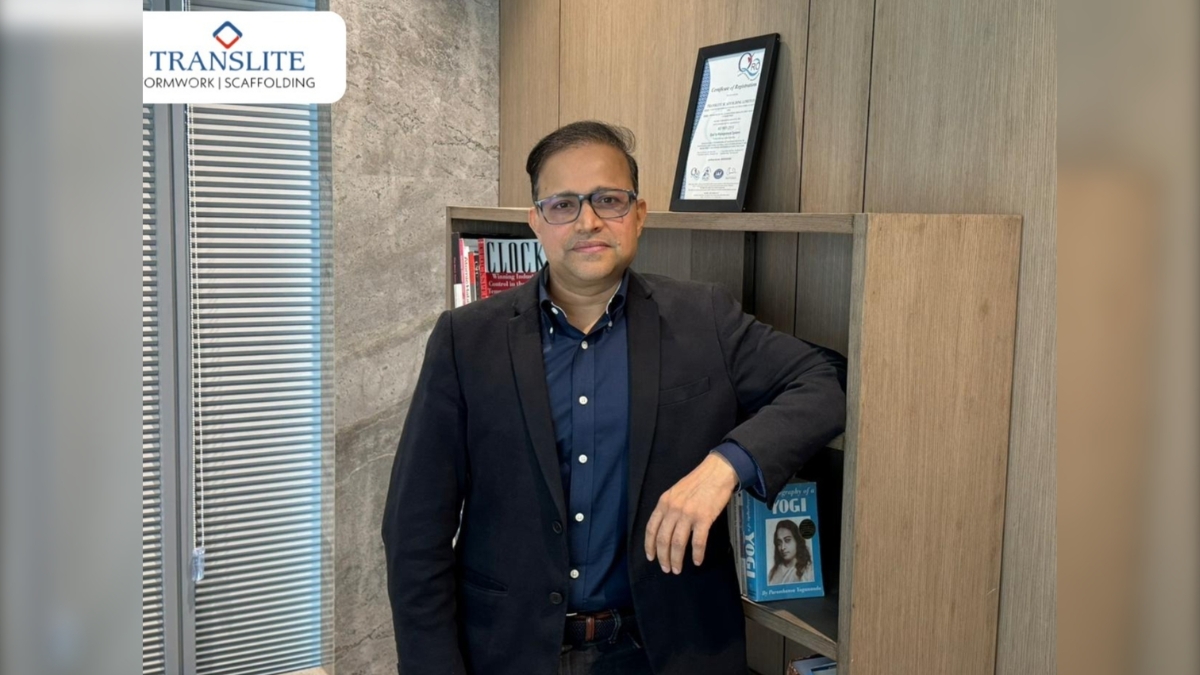
Mayank Pathak, Managing Director – Translite Formwork and Scaffolding
New Delhi [India], June 11: Airports are among the most demanding infrastructure projects to execute. Unlike many construction sites that operate in isolated zones, airport projects often develop alongside active passenger movement, operational facilities, security systems, and continuous logistics activity. Every stage of execution must be planned with precision because even minor disruptions can affect mobility, safety, and daily operations.
Modern airport construction also represents a larger shift in infrastructure expectations. Today’s airports are no longer viewed purely as transport hubs. They are designed as integrated urban spaces that combine architecture, sustainability, passenger experience, and engineering efficiency. This transformation has increased the complexity of construction execution, especially in large projects such as Bengaluru’s Terminal 2 development, which reflects the growing emphasis on scale, design integration, and operational continuity.
For companies involved in construction support systems, these projects highlight an important reality. Building modern infrastructure is not only about permanent structures. It also depends heavily on how temporary systems such as scaffolding, formwork, and access platforms are planned and managed during execution.
Why Airport Construction Requires a Different Approach
Airport projects operate under conditions that are very different from conventional construction environments. Work often takes place within active campuses where movement restrictions, security requirements, and operational schedules must be respected throughout the project cycle.
In high-traffic environments, construction access becomes a major challenge. Materials must be transported efficiently without affecting public circulation. Work zones must remain controlled and clearly separated from operational areas. Temporary support systems must also adapt to changing site conditions as different phases of the project progress simultaneously.
This is where detailed planning becomes essential. Scaffolding and formwork systems cannot be treated as secondary site arrangements. They must be integrated into the broader execution strategy from the beginning.
Managing Execution in Limited and Active Spaces
Large airport projects involve multiple work fronts operating together. Structural works, finishing activities, utilities, façade systems, and elevated access requirements often overlap within the same construction cycle.
In constrained environments, modular scaffolding systems offer practical advantages. Systems such as Ringlock and Cuplock scaffolding allow predictable assembly and flexibility in configuration. Because components are standardized, they can be adjusted to suit varying heights, curved architectural sections, and restricted work zones without extensive modification.
This adaptability is particularly important in airport environments where access pathways and operational movement cannot be obstructed for long durations. Faster assembly and dismantling help maintain workflow continuity while minimizing congestion across active construction areas.
Precision Becomes More Important in Architectural Projects
Modern airports place strong emphasis on design and passenger experience. Large open spans, elevated roofing systems, landscaped interiors, and integrated lighting create visually complex structures that demand careful execution.
Temporary support systems play a significant role in maintaining alignment and stability during these stages. Formwork and scaffolding must support structural loads while also accommodating architectural detailing and finishing activities.
In such projects, engineering planning becomes critical. Load calculations, staging layouts, and access design must be prepared well before execution begins. This reduces the need for adjustments on site and helps maintain consistency across different construction stages.
Companies involved in scaffolding and formwork support, including Translite Scaffolding Ltd., increasingly work within these requirements by aligning temporary support systems with structural and execution planning.
Safety in High-Movement Infrastructure Projects
Airport construction presents unique safety challenges because construction activity often takes place near operational zones. Maintaining safe movement for workers, contractors, and airport operations requires disciplined site management.
Temporary structures must provide stable working platforms while allowing efficient access across multiple elevations. Standardized systems help reduce variability during installation and support more predictable structural behaviour.
Manufacturing consistency also becomes important in such environments. Components fabricated to defined standards contribute to stability and reduce the risk of misalignment during assembly. In projects where multiple teams work simultaneously, predictable system performance helps improve coordination and safety.
The Role of Logistics and Material Flow
Material movement is one of the most sensitive aspects of airport construction. Large quantities of structural components, formwork materials, and scaffolding equipment must move through highly regulated environments without affecting operational areas.
Efficient logistics planning helps avoid bottlenecks. Modular systems support this process because components can be transported, assembled, dismantled, and redeployed with greater efficiency. Proper sequencing of deliveries and storage also helps reduce congestion in restricted workspaces.
For infrastructure support providers, understanding these logistical challenges is becoming increasingly important as projects shift toward more integrated and operationally sensitive environments.
Sustainability and Reusability in Modern Construction
Modern airport developments increasingly emphasize sustainability, both in architectural design and construction practices. Reusable scaffolding and modular formwork systems contribute to this objective by reducing material wastage and supporting long-term reuse across projects.
Durable systems fabricated with consistent specifications can be redeployed across multiple construction phases and future projects. This reduces unnecessary material replacement and supports more efficient resource utilization over time.
As infrastructure projects grow larger, reusable systems are becoming not only a cost consideration but also part of broader construction sustainability practices.
A Growing Need for Engineering-Led Construction Support
One of the key lessons from large airport developments is that temporary support systems must evolve alongside infrastructure complexity. As structures become larger and architectural requirements more demanding, scaffolding and formwork systems can no longer rely solely on conventional site practices.
Engineering-led planning, modularity, and standardization are becoming central to efficient execution. Temporary systems must be designed not only to support structural loads but also to align with project sequencing, safety planning, and operational movement.
This shift is gradually reshaping how infrastructure support systems are viewed within the construction ecosystem.
Looking Ahead
India’s infrastructure growth is moving toward increasingly complex urban and transport projects. Airports, metro systems, industrial corridors, and high-speed mobility networks all require stronger coordination between design and execution.
Projects such as Bengaluru’s airport expansion demonstrate how modern infrastructure depends on more than architectural ambition alone. Successful execution relies equally on the systems that support construction behind the scenes.
For companies working in scaffolding and formwork, this changing landscape presents both a challenge and an opportunity. As projects become more technically demanding, the role of engineered support systems will continue to grow in importance. Temporary structures may disappear once construction is complete, but during execution they remain one of the most important foundations supporting modern infrastructure development.
If you object to the content of this press release, please notify us at pr.error.rectification@gmail.com. We will respond and rectify the situation within 24 hours.
