

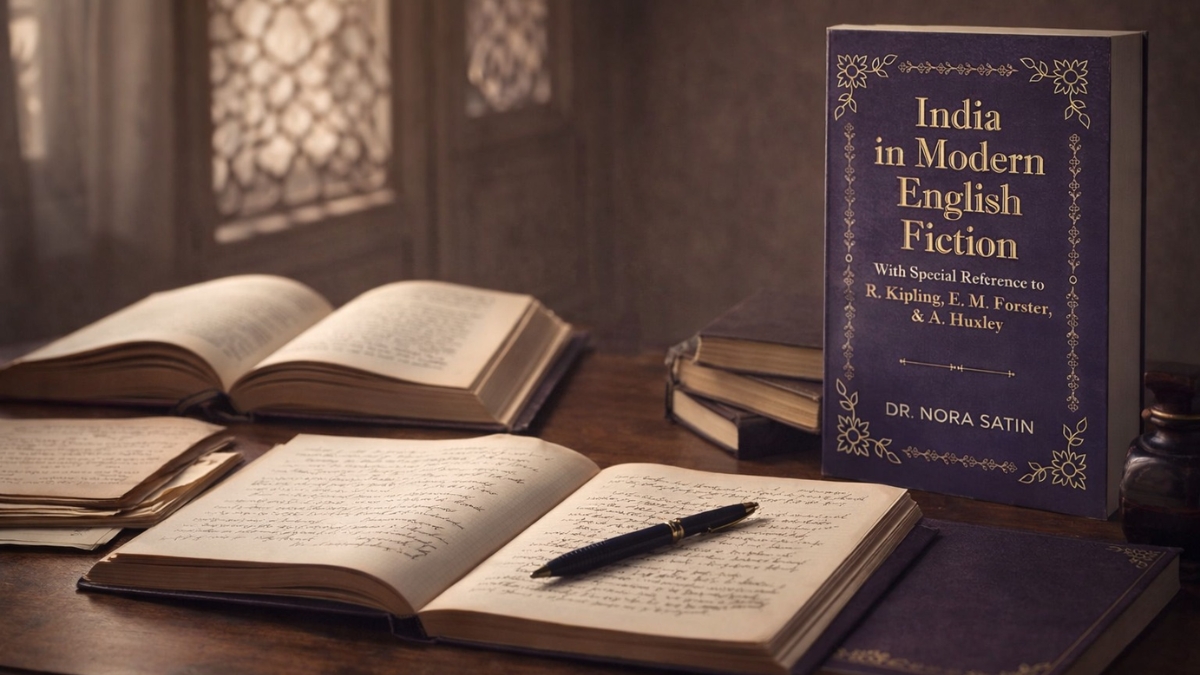
Some books do more than analyse literature. They open a conversation across time, culture, and consciousness.
New Delhi [India], April 11: In India in Modern English Fiction, Dr. Nora Satin examines how India was seen by major English writers across two centuries, not just as a place, but as an idea, a spiritual challenge, and at times, a mirror. Through writers such as Rudyard Kipling, E.M. Forster, and Aldous Huxley, her work traces a remarkable shift: from distance to curiosity, from empire to introspection, and from observation to humility.
In this conversation, Dr. Satin reflects on what first drew her to this subject, how Western literary perceptions of India evolved, and why that dialogue still matters today.
What first drew you to the idea of exploring India through the eyes of English novelists?
I grew up surrounded by both English and Indian literature, and I was always struck by how differently the same country could appear depending on who was writing about it. I wanted to understand that shift, how India moved from being treated as an exotic backdrop to becoming a place of introspection, spiritual inquiry, and moral questioning. For me, it felt like tracing a long journey from illusion toward a more honest kind of seeing.
Your book begins with early English depictions of India, including Milton, Dryden, and Scott. What did those narratives reveal to you?
They revealed how much imagination preceded real understanding. For many early English writers, India existed more as a symbol than a lived reality, a land of splendour, mystery, distance, and fantasy. That image was powerful, but it was also deeply incomplete. Those early representations mattered because they helped shape the Western literary imagination long before deeper cultural understanding had a chance to develop.
You describe Kipling as both sympathetic to and critical of Anglo-India. How do you understand that tension?
Kipling is fascinating precisely because he is not simple. He understood the machinery of empire from within, but he also saw its strain, loneliness, and hypocrisy. There is sympathy in his work, but there is also unease. He writes with authority, yet underneath that authority there is often exhaustion, irony, and moral discomfort. That contradiction is what makes him so enduring as a subject of study.
Forster’s ‘passage to India’ — was it a search fulfilled, or a question left unanswered?
I think it remains, very deliberately, an unanswered question. Forster longed for connection between people, between cultures, and between souls, but he was too honest a novelist to offer an easy resolution. A Passage to India ends with separation, but not with cynicism. The possibility of friendship still hovers there, almost like a moral hope. That is part of what gives the novel its lasting emotional power.
Huxley began as a critic of Indian spirituality and later became one of its admirers. What changed him?
Disillusionment changed him. The crises of the modern West, especially war, mechanisation, and spiritual emptiness, forced many thinkers to ask whether reason alone was enough. Huxley’s later engagement with Indian philosophy reflects that hunger for balance. He began to see that inner life, contemplation, and consciousness were not signs of backwardness, but forms of wisdom the modern world had neglected.
Your conclusion suggests that India evolved, in Western thought, from a land of regret to a land of meaning. What does that idea mean to you now?
It means that India came to represent something deeper than geography. For many Western writers and thinkers, it became a source of perspective, not simply a place of difference, but a place of significance. In a world still obsessed with speed, achievement, and control, India continues to offer an alternative language, one shaped by reflection, inner life, and the search for meaning beyond material success.
After spending so many years studying how others wrote about India, what does India mean to you today?
To me, India is not a fixed subject. It is an ongoing conversation. It is a civilisational presence that keeps resisting reduction. The more I studied it, the less I felt I was studying an object and the more I felt I was entering a dialogue, one between literature and history, faith and intellect, East and West, self and world. That conversation is still unfolding.
At its heart, India in Modern English Fiction is not only a work of criticism. It is also a reflection on perception itself, on how cultures imagine one another, how literature carries both misunderstanding and revelation, and how serious reading can become a form of listening.
Dr. Nora Satin’s work reminds us that India’s place in English literature has never been static. It has moved through fascination, distortion, conflict, and insight. In that movement, it has also revealed something about the West’s own evolution, its doubts, its longings, and its search for a deeper centre.
About the book: India in Modern English Fiction by Dr. Nora Satin explores how writers such as Kipling, Forster, and Huxley interpreted India across empire, culture, and spirituality.
Media and publicity: For interviews, review copies, podcast invitations, feature requests, and literary coverage, please contact Edioak at media@edioak.com, which is managing the book’s publicity and outreach.
For more about the author, visit www.drnorasatin.com.
